
0%
In This Article:
What Is AI Search for E-Commerce?
Traditional E-Commerce Search vs AI Search
How AI Is Changing E-Commerce Product Discovery
How AI Search Works in E-Commerce
What E-Commerce Stores Need for Better AI Product Discovery
How to Improve AI Search in an Online Store
How to Measure AI Search Performance
FAQ
More shoppers now ask AI to find products for them. Morgan Stanley Research estimates that by 2030, AI shopping assistants could account for $190 billion to $385 billion in US e-commerce spending, or 10% to 20% of the market.
People who shop through an assistant bring the same habits to your store. They type “waterproof hiking boots for wide feet under $150” and get zero results or a page of socks. Baymard Institute’s search UX benchmark found that 56% of e-commerce sites fail to adequately support users’ search needs.
Below, you’ll see how AI search reads shopper intent and what to fix in your catalog so the right products show up.
Main Takeaways
AI Search Reads Intent: It matches the meaning of a query, so shoppers find products even when their words differ from yours.
Discovery Gets Shorter: Plain-language queries, follow-up questions and visual search take shoppers from a need to a short list faster.
Data Decides the Results: AI search can only rank what your catalog describes, so complete attributes and clean feeds matter more than the tool.
Measure What Happens Next: Zero-result rate, product CTR, add-to-cart rate and search conversion show whether search works.
What Is AI Search for E-Commerce?
AI search for e-commerce is site search that uses natural language processing and machine learning to work out what a shopper wants from the words they type. It matches a query against product attributes and catalog data, then ranks results by how well they fit.
AI-powered e-commerce search also handles extra conditions in one query, such as size, budget, occasion or compatibility. A search for “gift for a coffee lover under $50” returns grinders, mugs and bean subscriptions in that price range, even if none of them has “gift” in its title.
AI search now works in two places: the search bar on your store and AI assistants such as ChatGPT, Gemini and Perplexity. Shopify stores can even connect their catalog to ChatGPT. This article focuses on on-site search, but the same product data feeds both.
On-site search is one of the most visible uses of AI in e-commerce, because shoppers talk to it directly. Good results take them to the right product in seconds, and poor results often make them leave the store.
Traditional E-Commerce Search vs AI Search
Traditional e-commerce search matches the words in a query to the words in your product data, while AI search matches the meaning behind them. The table shows where the two approaches differ.
Traditional Search | AI Search |
|---|---|
Exact keywords | Meaning and intent |
Predefined synonyms | Semantic relationships |
Short queries | Natural-language queries |
Static ranking | Contextual relevance |
Search + filters | Conversational refinement |
Limited product context | Rich product attributes and catalog data |
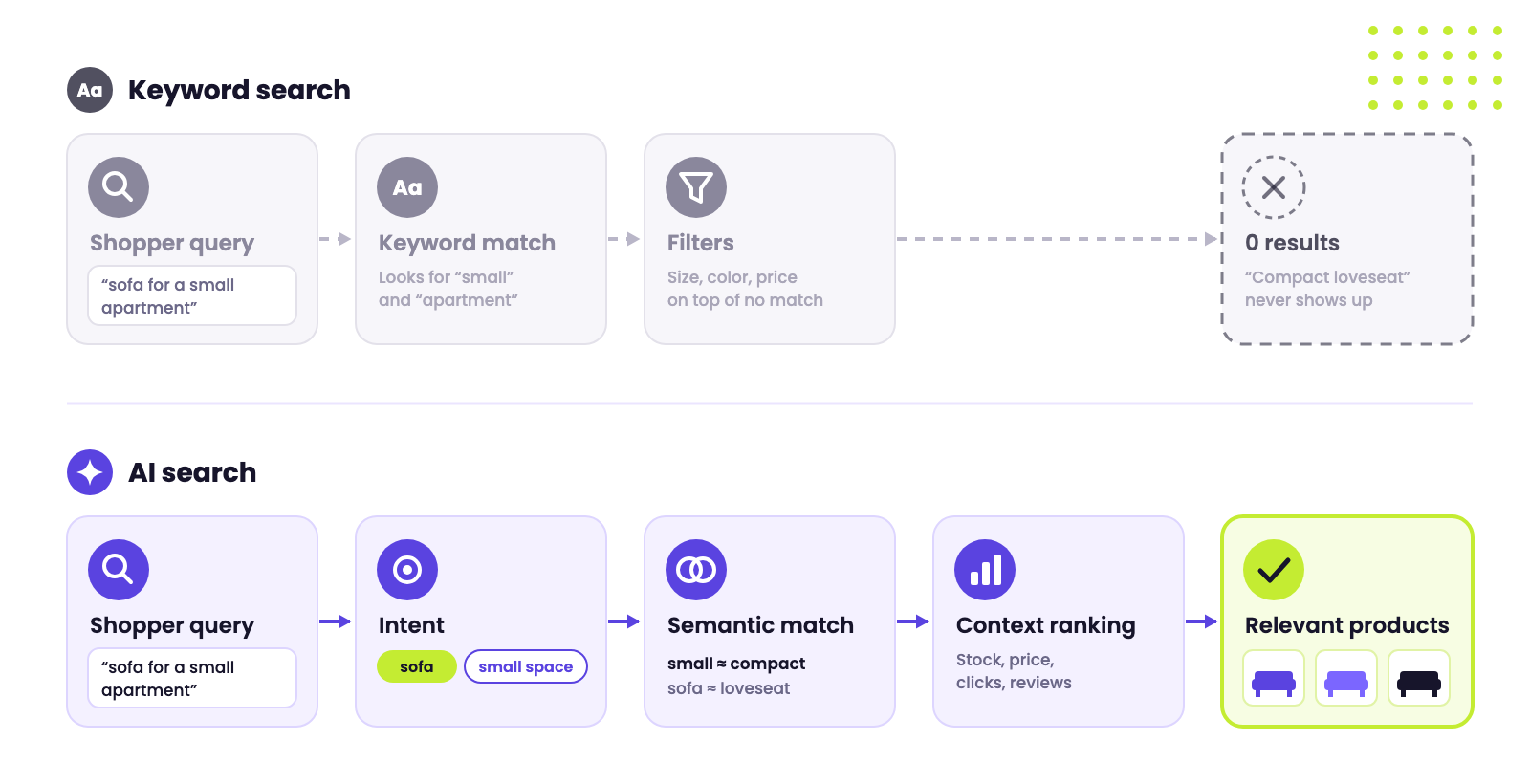
In practice, keyword search breaks on the queries real people write. A shopper who types “sofa for a small apartment” gets nothing if your catalog says “compact loveseat.” AI search closes that gap because it compares meanings, so “small apartment” and “compact” land close together.
AI doesn’t replace the basics, though. Autocomplete, typo tolerance, filters and clear result pages from e-commerce site search best practices still do much of the work.
How AI Is Changing E-Commerce Product Discovery
AI is changing e-commerce product discovery, the path from a need to a chosen product, in six ways. Shoppers search in natural language, search reads meaning, results use context, search turns into a dialogue, discovery goes beyond text, and hidden products start to show up.
Shoppers Can Search in Natural Language
Shoppers no longer have to guess the right product keyword. They can describe a use case, a budget, a problem or an occasion, like “running shoes for flat feet under $120.” AI search pulls each condition out of the sentence and applies it, so a longer query gives more precise results.
Search Understands Meaning, Not Just Keywords
Semantic search compares what words mean, so it links “couch” with “sofa” and “sneakers” with “trainers.” It also knows how concepts relate, such as “camping” and “tent stakes.” Your team no longer has to keep long synonym lists by hand to catch every way a shopper phrases a need.
Product Discovery Becomes More Contextual
AI search ranks results with more than the query in mind. It can weigh attributes, price, stock, earlier clicks in the session and merchandising signals like new arrivals. Two people who type the same words can see a different order of products, each closer to what they’re likely to buy.
Search Becomes Conversational
Conversational AI lets shoppers refine results the way they’d talk to a sales assistant. Someone asks for a laptop for video editing, gets a few options, adds “lighter than 2 kg,” compares two models and picks one. Each new condition narrows the list without a fresh search.
Product Discovery Goes Beyond Text Search
Shoppers can now search with a photo, their voice or both. Visual search finds lookalike products from a picture, so someone who spots a lamp in a café can upload a photo and get similar ones. Voice and multimodal search help most on mobile, where long queries are a pain to type.
AI Can Surface Products Shoppers Would Not Find With Exact-Match Search
Long-tail products often stay hidden because they have unusual names or sit deep in a large catalog. AI search finds them by meaning, which matters most in complex categories like auto parts or industrial supplies. It also helps shoppers who start with only a vague idea of what they want.
How AI Search Works in E-Commerce
AI search works in a loop: it reads the query, finds products with a matching meaning, then ranks them with catalog, behavior and business data. These are the main parts behind that loop.
Query Understanding: Natural language processing (NLP) splits the query into intent, product type and conditions like size, color or price, and fixes typos along the way.
Semantic Matching and Vector Search: Queries and products are turned into vectors, number codes for meaning, so the engine can find close matches even without shared words.
Product Attributes and Catalog Data: Structured fields such as material, size and compatibility let the engine apply hard limits that semantic matching alone can’t check.
Search Ranking: A ranking model orders matches by relevance, often with a mix of keyword and vector scores, since SKUs and exact names still need keyword search.
Behavioral Signals and Personalization: Clicks, add-to-carts and past orders show which results satisfy shoppers, and personal history can move preferred brands or sizes higher.
Merchandising Rules: Your team can still pin, promote or bury products for promotions, stock levels or margins on top of what the model decides.
Most stores don’t build their own model. They plug a ready-made AI e-commerce site search engine into Magento, Shopify or WooCommerce, and this list of AI tools for online stores covers popular options.
Is Your Search Box Losing Shoppers?
Our e-commerce consultants review your site search data, find the queries that fail, and plan the catalog and AI search changes that get shoppers to the right products.
Audit My Store SearchWhat E-Commerce Stores Need for Better AI Product Discovery
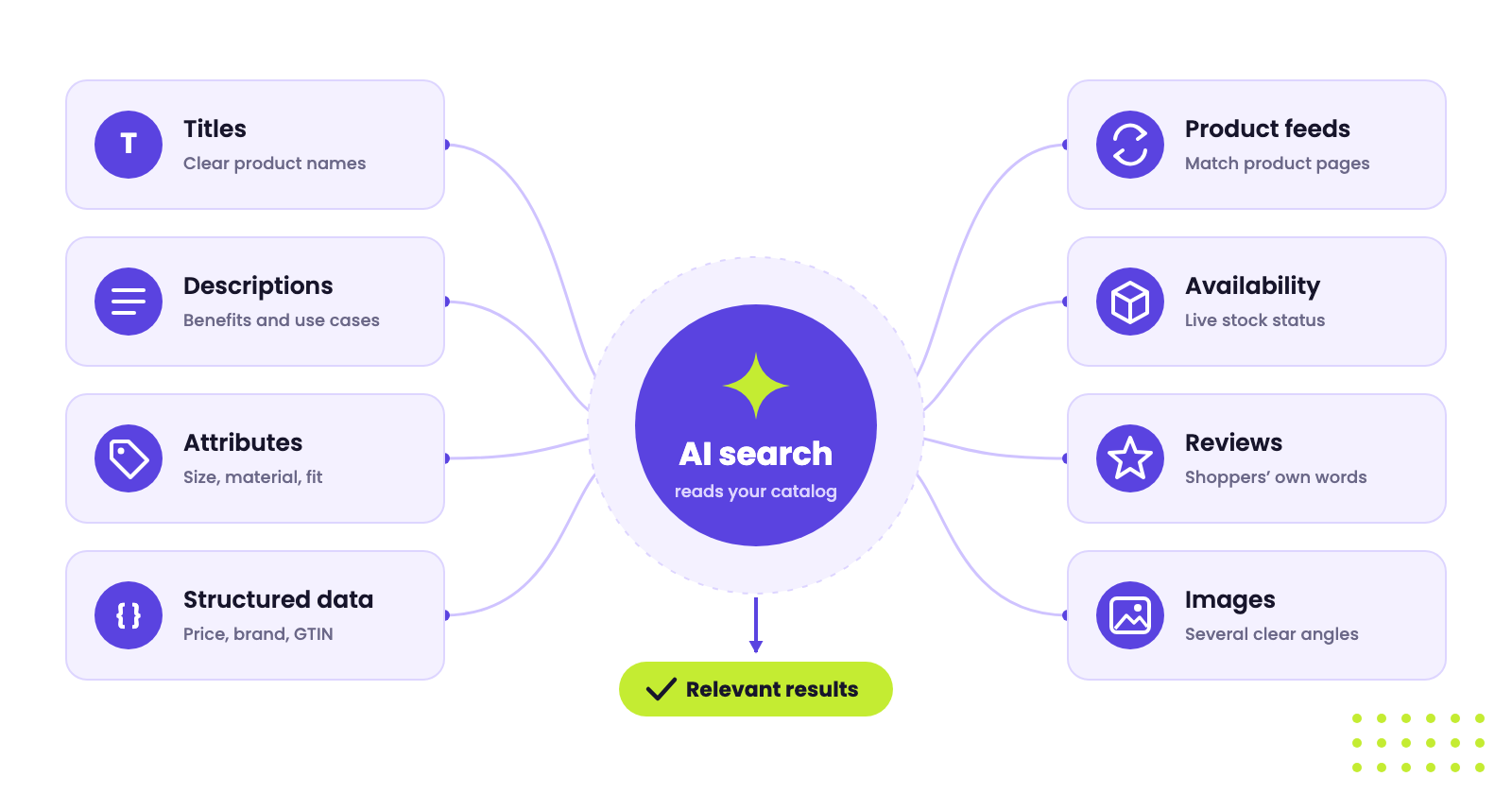
AI product discovery works only as well as the product data behind it, since the engine can match and rank only what your catalog describes. Stores need complete and structured data, accurate feeds, clear content, good images and a clean catalog.
Complete Product Data
Every product needs a clear title, a useful description, the right category and full attributes, including variants, specs, compatibility and use cases. If a jacket’s listing never says it’s waterproof, AI search can’t return it for “rain jacket.” The same happens with size, material or compatibility: when a field is empty, searches that ask about it skip the product.
Structured Product Data
Structured data puts facts like price, availability, brand, identifiers (GTIN, MPN), ratings and reviews into fixed fields. Filters and AI tools read it reliably, and the same markup supports your e-commerce SEO. Google’s product structured data guide lists the fields it reads.
Accurate Product Feeds
Product feeds send your catalog to Google Shopping, marketplaces and AI assistants, so they must match your product pages. A price or stock status that differs between feed and page confuses shoppers and can get listings rejected. Sync feeds from one source, such as your ERP or order management system.
Clear Product Content
Product pages should answer the questions shoppers ask in search: benefits, use cases, specs, comparisons with similar models and FAQs. Reviews add the words real people use, such as “runs small” or “good for wide feet.” Semantic search draws on all of that text to match long queries.
High-Quality Product Images
Visual and multimodal search compare the pictures themselves, so they need clear photos from several angles on a clean background. Lifestyle shots show context, like a sofa in a small room. Descriptive file names and alt text give each image a text layer that regular search can read too.
Clean and Consistent Catalog Data
Inconsistent naming, missing attributes, duplicates, outdated stock and wrong categories all confuse ranking. If one supplier writes “navy” and another “dark blue,” filters split the same color in two. Regular catalog audits and solid inventory management keep this data reliable.
How to Improve AI Search in an Online Store
To improve AI search in an online store, start with what shoppers already type, fix the catalog data behind failed queries, then test and measure. These ten steps cover the usual work.
Analyze Site Search Queries: Export the last few months of searches and group them by intent to see what shoppers really want.
Review Zero-Result Searches: Each empty result page points to a missing product, synonym or attribute.
Find Repeated Refinements: When people rephrase the same search several times, the first results didn’t fit.
Improve Product Attributes: Fill in the fields that failed queries ask about, like size, material or compatibility.
Clean Up Catalog Data: Merge duplicates, fix categories and use one naming standard for colors, sizes and units.
Test Natural-Language Queries: Type long, specific requests the way customers do and check whether the top results make sense.
Tune Search Relevance: Balance keyword and semantic matching so SKUs and exact product names still rank first.
Review Filters and Merchandising Rules: Remove old boosts and make sure filters reflect the attributes shoppers search for.
Test on Mobile and Desktop: Check autocomplete, result layout and voice input on both, since search shapes the e-commerce user experience on small screens.
Measure Behavior After Search: Track what people do after each search, such as clicks, add-to-carts and exits.
Data mapping, engine setup and relevance tests take developer time. If your team is short on it, e-commerce web development services can handle the technical part while you focus on the catalog.
How to Measure AI Search Performance
Measure AI search performance by what shoppers do after they search: whether they find, click, add to cart and buy. Compare these metrics before and after launch, and track search users apart from shoppers who only browse.
Metric | What It Shows |
|---|---|
Search conversion rate | Whether search users complete purchases |
Zero-result rate | How often search fails to return useful products |
Product CTR | Whether results are relevant enough to click |
Add-to-cart rate | Whether discovered products match shopper needs |
Search exit rate | Whether shoppers leave after using search |
Query refinement rate | How often users need to reformulate searches |
Revenue per search session | Commercial value of search-driven sessions |
Read the metrics together. A falling zero-result rate means little if the query refinement rate climbs, since shoppers still have to rephrase. If the numbers stall, a UX audit of the search page often shows where people drop off.
Improve Product Discovery With Expert Support
AI search lets shoppers describe what they need in their own words and still get the right products. How well it works depends on your product data, feeds and relevance tests as much as on the engine. If you’d like help with that setup, get in touch with our team.
FAQ
How does AI improve e-commerce product discovery?
AI improves product discovery by reading the intent behind a query and matching it to products with the right attributes. Shoppers can describe a need in plain language, refine results in a dialogue or search with a photo. They reach a short list of fitting products faster, and items with odd names no longer get lost.
How does semantic search work in e-commerce?
Semantic search turns queries and product data into vectors that represent meaning. The engine then returns products whose vectors sit close to the query’s, even with no shared keywords. That’s how “couch for a studio flat” can find a listing called “compact two-seat sofa.”
What is conversational search in e-commerce?
Conversational search lets shoppers find products through a back-and-forth exchange, much like a chat with a store assistant. The shopper states a need, sees options, adds conditions and compares products. The system keeps the earlier context, so each answer narrows the list.
What product data does AI search need?
AI search needs complete titles, descriptions, categories and attributes, plus structured fields such as price, availability, brand, identifiers and reviews. Clear images help visual search. All of it should match across product pages and feeds, with no duplicates or outdated stock.
Can AI search improve e-commerce conversions?
It can, because shoppers who find a fitting product quickly are more likely to buy. The gain depends on your catalog data and on how well the engine is tuned, so results differ from store to store. Track search conversion and zero-result rates before and after launch to see the real effect.
What is the difference between AI search and product recommendations?
AI search responds to a request, so it starts from the shopper’s own words, photo or voice query. Product recommendations appear without a request, based on behavior, the current product or what similar shoppers bought. Many stores run both on the same catalog data and behavior signals.

Expert in creating engaging written content. Skilled at analyzing audience behaviors and refining strategies to align business goals with customer interests. Proven ability to craft content that connects deeply with audiences. Passionate about staying current with trends to boost engagement.
Expert in creating engaging written content. Skilled at analyzing audience behaviors and refining strategies to align business goals with customer interests. Proven ability to craft content that connects deeply with audiences. Passionate about staying current with trends to boost engagement.