
0%
In This Article:
What Are ERP, OMS, and WMS?
ERP vs OMS vs WMS: Key Differences
ERP for E-commerce: When Do You Need It?
OMS for E-commerce: When Do You Need It?
WMS for E-commerce: When Do You Need It?
How to Choose Between ERP, OMS, and WMS for Your E-commerce Business?
How ERP, OMS, and WMS Work Together in E-commerce
Common ERP, OMS, and WMS Integration Challenges and Solutions
FAQ
The global ERP software market is projected to reach $157.1 billion by 2033, which shows the growing demand for business systems that help companies manage complex operations. As e-commerce businesses grow, many merchants face difficulties when they select between ERP, OMS, and WMS solutions. Although these platforms may seem similar, each one addresses different operational challenges.
This guide explains the key differences between ERP, OMS, and WMS for e-commerce and shows how to choose the right system based on your business needs and growth plans.
What Are ERP, OMS, and WMS?
ERP, OMS, and WMS are three types of business software that support different parts of e-commerce operations. While these systems can share some functions, each one focuses on a specific area: company-wide processes, order management, or warehouse operations.
- Enterprise Resource Planning (ERP) is a system that connects core business processes such as finance, purchasing, inventory, sales, and reporting. It provides a central source of business data and helps companies manage resources across different departments.
- Order Management System (OMS) controls the order lifecycle across multiple sales channels. It helps merchants process orders, manage inventory availability, coordinate fulfillment, and provide accurate order status information to customers.
- Warehouse Management System (WMS) focuses on warehouse operations. It helps businesses manage stock locations, picking, packing, shipping, and warehouse workflows to improve fulfillment accuracy and efficiency.
ERP vs OMS vs WMS: Key Differences
Although ERP, OMS, and WMS platforms can work with the same business data, they solve different problems. The main difference is their primary focus: ERP manages company-wide processes, OMS manages order flows, and WMS manages warehouse activities, while dedicated e-commerce inventory management software helps businesses improve stock control and visibility.
| Aspect | ERP | OMS | WMS |
|---|---|---|---|
| Primary Purpose | Manage core business processes and resources | Manage the order lifecycle across sales channels | Manage warehouse operations and inventory movement |
| Main Focus | Finance, purchasing, inventory, sales, reporting | Order processing, fulfillment coordination, inventory availability | Stock locations, picking, packing, shipping |
| Best For | Businesses with complex operations across multiple departments | Retailers with multiple sales channels and complex order flows | Companies with large warehouses or advanced fulfillment processes |
| Key Users | Finance teams, managers, operations teams | Sales teams, customer service teams, operations teams | Warehouse teams and fulfillment managers |
| Main Benefit | Centralized business data and process control | Accurate order processing and better customer experience | Faster and more accurate warehouse workflows |
| Common Integrations | CRM, accounting software, e-commerce platforms, OMS, WMS | E-commerce platforms, marketplaces, ERP, WMS, shipping providers | ERP, OMS, inventory systems, shipping carriers |
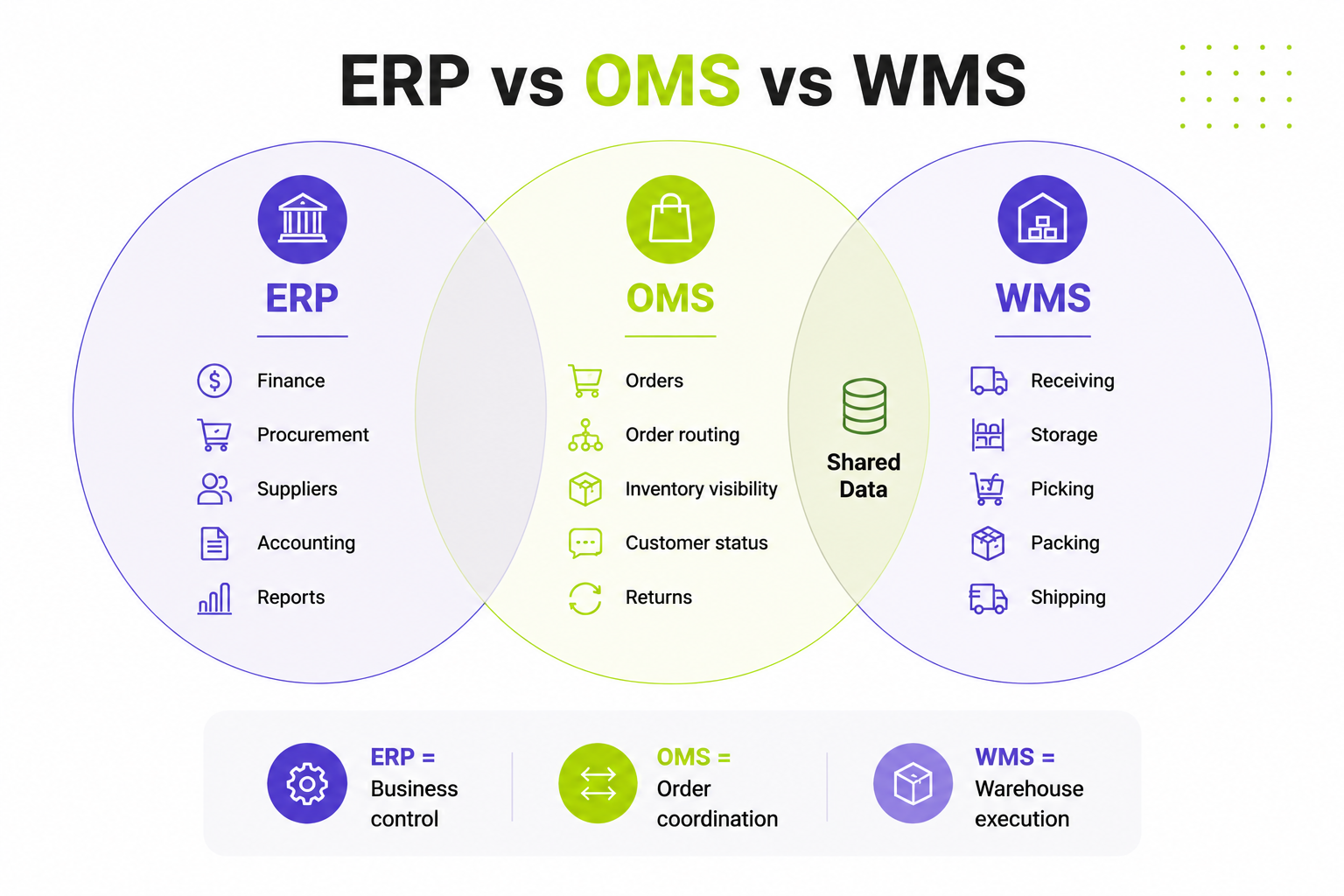
The right solution depends on where your business faces the biggest operational challenges. A small online store may only need an OMS or basic inventory tools, while a large retailer may require a combination of ERP, OMS, and WMS to support complex workflows.
Need an E-commerce Platform That Scales?Build a flexible online store ready for complex integrations and business growth. Build Your E-commerce Store |
ERP for E-commerce: When Do You Need It?
An Enterprise Resource Planning (ERP) system connects key business processes such as finance, purchasing, inventory, sales, and reporting. For e-commerce companies, ERP acts as a central system that stores and synchronizes important business data across different departments and platforms.
Key ERP Functions for E-commerce
An ERP system can help merchants manage:
- Inventory Data – Keep stock information accurate across sales channels and business operations.
- Financial Operations – Manage accounting data, payments, expenses, and financial reports.
- Product Information – Store product details, supplier data, and purchasing records.
- Order Data – Connect online orders with internal business processes and fulfillment workflows.
- Business Reports – Provide insights into sales, costs, inventory levels, and overall performance.
Signs Your E-commerce Business Needs an ERP System
An ERP solution may be the right choice if your business:
- Sells products through multiple channels, such as an online store, marketplaces, and physical locations.
- Has complex inventory, purchasing, or supplier management processes.
- Needs accurate financial and operational reports from one system.
- Spends too much time managing data across separate tools.
- Plans to scale operations and requires better control over business processes.
ERP is usually not the first system a small e-commerce store needs. However, as order volume, product range, and operational complexity increase, an ERP can provide the structure required for sustainable growth.
OMS for E-commerce: When Do You Need It?
An Order Management System (OMS) helps e-commerce businesses control the entire order lifecycle across different sales channels. It connects customer orders, inventory data, fulfillment processes, and shipping information to create a consistent order flow.
Key OMS Functions for E-commerce
An OMS system can help merchants manage:
- Order Processing – Collect and organize orders from online stores, marketplaces, and other sales channels in one place.
- Inventory Availability – Provide accurate stock information and prevent overselling across multiple channels.
- Order Routing – Select the most suitable warehouse, store, or fulfillment location for each order.
- Fulfillment Coordination – Connect order data with shipping providers, warehouses, and third-party logistics services.
- Customer Order Updates – Provide accurate order status information from purchase to delivery.
Signs Your E-commerce Business Needs an OMS System
An OMS solution may be the right choice if your business:
- Receives orders from multiple sales channels.
- Has several warehouses or fulfillment locations.
- Needs better control over order processing and delivery workflows.
- Experiences inventory synchronization issues between platforms.
- Wants to improve order accuracy and customer experience.
An OMS is especially useful for retailers that need a clear view of orders across different channels. While ERP focuses on overall business processes, OMS focuses on the customer order journey and fulfillment coordination.
WMS for E-commerce: When Do You Need It?
A Warehouse Management System (WMS) helps e-commerce businesses control warehouse operations, from inventory placement to order fulfillment. It is one part of a broader e-commerce inventory management strategy that covers stock tracking, replenishment, and inventory optimization.
Key WMS Functions for E-commerce
A WMS system can help merchants manage:
- Inventory Locations – Track where each product is stored inside the warehouse and maintain accurate stock records.
- Picking and Packing – Organize warehouse tasks to reduce errors and speed up order preparation.
- Shipping Operations – Support shipment processing, label creation, and carrier coordination.
- Stock Movement – Monitor receiving, transfers, returns, and inventory adjustments.
- Warehouse Reports – Provide data about stock levels, order processing speed, and warehouse performance.
Signs Your E-commerce Business Needs a WMS System
A WMS solution may be the right choice if your business:
- Manages a large product catalog or high order volume.
- Operates one or multiple warehouses.
- Faces frequent picking, packing, or inventory accuracy issues.
- Needs better visibility into warehouse processes.
- Uses complex fulfillment workflows.
A WMS is most valuable when warehouse operations become too complex for basic inventory tools. While ERP manages broader business processes and OMS controls order flows, WMS focuses on the physical movement of products and warehouse efficiency.
How to Choose Between ERP, OMS, and WMS for Your E-commerce Business?
The right system depends on the operational challenges your business needs to solve. Instead of choosing a platform based only on features, identify which processes create the biggest limitations for your team.
| If Your Main Challenge Is... | Consider... | Because You Need To... |
|---|---|---|
| Managing finance, purchasing, suppliers, and business data | ERP | Create a central system for core business operations and improve visibility across departments |
| Processing orders from multiple sales channels | OMS | Control order flows, coordinate fulfillment, and maintain accurate inventory visibility |
| Managing warehouse tasks and stock movement | WMS | Improve picking, packing, shipping, and inventory accuracy |
| Connecting complex operations across multiple channels and locations | ERP + OMS + WMS | Combine business management, order processing, and warehouse workflows in one ecosystem |
For small e-commerce businesses, a single platform or basic inventory solution may be enough. However, companies with multiple sales channels, large product catalogs, or complex fulfillment processes often need a combination of ERP, OMS, and WMS to support growth.
How ERP, OMS, and WMS Work Together in E-commerce
ERP, OMS, and WMS do not always work as separate solutions. For many growing e-commerce businesses, these systems form a connected workflow where each platform manages a specific stage of the product and order lifecycle.
1. Product and Inventory Planning: ERP
The process often starts in the ERP system. Businesses use ERP to manage supplier information, purchasing, product data, financial records, and overall inventory planning.
When stock needs to be replenished, ERP helps teams manage purchasing decisions and maintain accurate business data.
2. Order Processing: OMS
When a customer places an order through an online store, marketplace, or another sales channel, the OMS manages the next steps.
It checks inventory availability, selects the best fulfillment option, and coordinates the order flow between sales channels, warehouses, and other connected systems.
3. Order Fulfillment: WMS
After OMS confirms the order, WMS manages the warehouse process. It helps warehouse teams locate products, prepare orders, handle packing, and arrange shipments.
Once the order is completed, inventory updates can be shared with OMS and ERP to keep business data accurate.
Example: From Customer Order to Delivery
A typical e-commerce workflow looks like this:
Supplier → ERP → Online Store → OMS → WMS → Customer
- ERP manages product, supplier, purchasing, and inventory information.
- OMS processes customer orders and coordinates fulfillment.
- WMS handles warehouse operations and shipment preparation.
- Connected systems share updates to maintain accurate inventory and order information.
When ERP, OMS, and WMS work together, businesses can create a more reliable workflow, reduce manual tasks, and improve visibility across sales, inventory, and fulfillment operations.
Common ERP, OMS, and WMS Integration Challenges and Solutions
ERP, OMS, and WMS integrations help e-commerce businesses create connected workflows, but poor planning or incorrect configuration can lead to operational issues. Understanding common challenges before implementation helps businesses avoid data errors, fulfillment delays, and inefficient processes.
| Challenge | Solution |
|---|---|
| Inconsistent Inventory Data | Define which system acts as the source of truth for inventory data and ensure all connected platforms receive accurate stock updates. Regular synchronization checks can help detect and resolve discrepancies. |
| Overselling and Stock Availability Errors | Connect sales channels, OMS, and inventory systems through real-time or scheduled data synchronization to keep product availability accurate. |
| Manual Order Processing | Automate data exchange between e-commerce platforms, OMS, WMS, and shipping providers to reduce manual work and minimize order processing errors. |
| Unclear System Responsibilities | Define which platform manages each type of data. For example, ERP can manage business information, OMS can control order workflows, and WMS can handle warehouse operations. |
| Complex Integrations | Plan the integration architecture in advance and use suitable APIs, connectors, or custom solutions that match your existing technology stack. |
| Limited Future Scalability | Select systems that can support higher order volumes, additional sales channels, and new fulfillment locations as the business grows. |
A successful ERP, OMS, and WMS integration requires accurate data exchange, clear workflows, and a system architecture that supports both current operations and future business needs.
ERP vs OMS vs WMS: Which One Is Right for Your Business?
ERP, OMS, and WMS solve different e-commerce challenges, so the right choice depends on your business size, sales channels, order volume, and operational needs.
Choose ERP for better control over finance, purchasing, and business data. Choose OMS for managing orders across multiple channels. Choose WMS for improving warehouse operations and fulfillment accuracy.
Many growing e-commerce businesses use a combination of these systems to create a connected workflow, improve data accuracy, and support future growth.
If you need help with system selection, integration, or e-commerce technology strategy, the experts at Transform Agency can help you choose and implement the right solution for your business.
FAQ
What is the difference between ERP, OMS, and WMS?
ERP manages core business processes such as finance, purchasing, sales, and reporting. OMS manages the order lifecycle across different sales channels, while WMS focuses on warehouse operations, including inventory locations, picking, packing, and shipping.
Does an e-commerce business need an ERP, OMS, and WMS?
Not every e-commerce business needs all three systems. Small businesses may only need basic order and inventory tools, while larger companies with multiple channels, warehouses, and complex workflows may benefit from a combination of ERP, OMS, and WMS.
Can an ERP replace an OMS?
An ERP can handle some order-related processes, but it usually does not replace a dedicated OMS for complex e-commerce operations. OMS platforms provide specialized features for multi-channel order management, fulfillment coordination, and real-time inventory availability.
What is the difference between an OMS and a WMS?
An OMS manages customer orders and coordinates fulfillment across sales channels. A WMS manages warehouse activities, including stock movement, picking, packing, and shipping. OMS focuses on the order flow, while WMS focuses on physical warehouse operations.
How do ERP, OMS, and WMS work together?
ERP, OMS, and WMS support different parts of the e-commerce workflow. ERP manages business data, OMS controls order processing, and WMS handles warehouse fulfillment. When integrated, these systems provide accurate data exchange and a more efficient order-to-delivery process.

With 7 years of experience in the IT industry, Yaroslav specializes in e-commerce solutions. He has developed approximately 15 online stores, ranging from medium-sized shops to large marketplaces, gaining extensive experience across various industries including financial services, retail & distribution, and life sciences & healthcare. Skilled in Adobe Commerce, he excels in frontend development solutions for this CMS.
With 7 years of experience in the IT industry, Yaroslav specializes in e-commerce solutions. He has developed approximately 15 online stores, ranging from medium-sized shops to large marketplaces, gaining extensive experience across various industries including financial services, retail & distribution, and life sciences & healthcare. Skilled in Adobe Commerce, he excels in frontend development solutions for this CMS.