
0%
In This Article:
What Is E-commerce SEO?
How Is E-commerce SEO Different from Traditional SEO?
How E-commerce SEO Helps Online Stores Grow
E-commerce SEO in Action: The Titan Rig Case
Key Components of E-commerce SEO
How to Build an E-commerce SEO Strategy
Common E-commerce SEO Mistakes to Avoid
How Long Does E-commerce SEO Take to Show Results?
How to Measure E-commerce SEO Success
Is E-commerce SEO Worth the Investment?
FAQ
An analysis of more than 20,000 e-commerce websites found that the average online store receives an estimated 9,625 organic visits per month traffic that could cost nearly £11,800 per month to acquire through paid search. This demonstrates how valuable search visibility can be for an e-commerce business.
However, ranking an online store can be challenging. Technical issues, duplicate content, weak product pages, and strong competition may prevent customers from finding its products.
E-commerce SEO helps address these issues. This article explains what it is, how it works, and how it can increase organic traffic, product visibility, and sales.
What Is E-commerce SEO?
E-commerce SEO is the process of optimizing an online store so that its product, category, and informational pages appear higher in search engine results. Its goal is to help potential customers discover relevant products when they search for them online.
It combines keyword research, content optimization, technical improvements, site structure, internal linking, and authority building. Unlike paid advertising, SEO focuses on generating organic traffic without paying for every click.
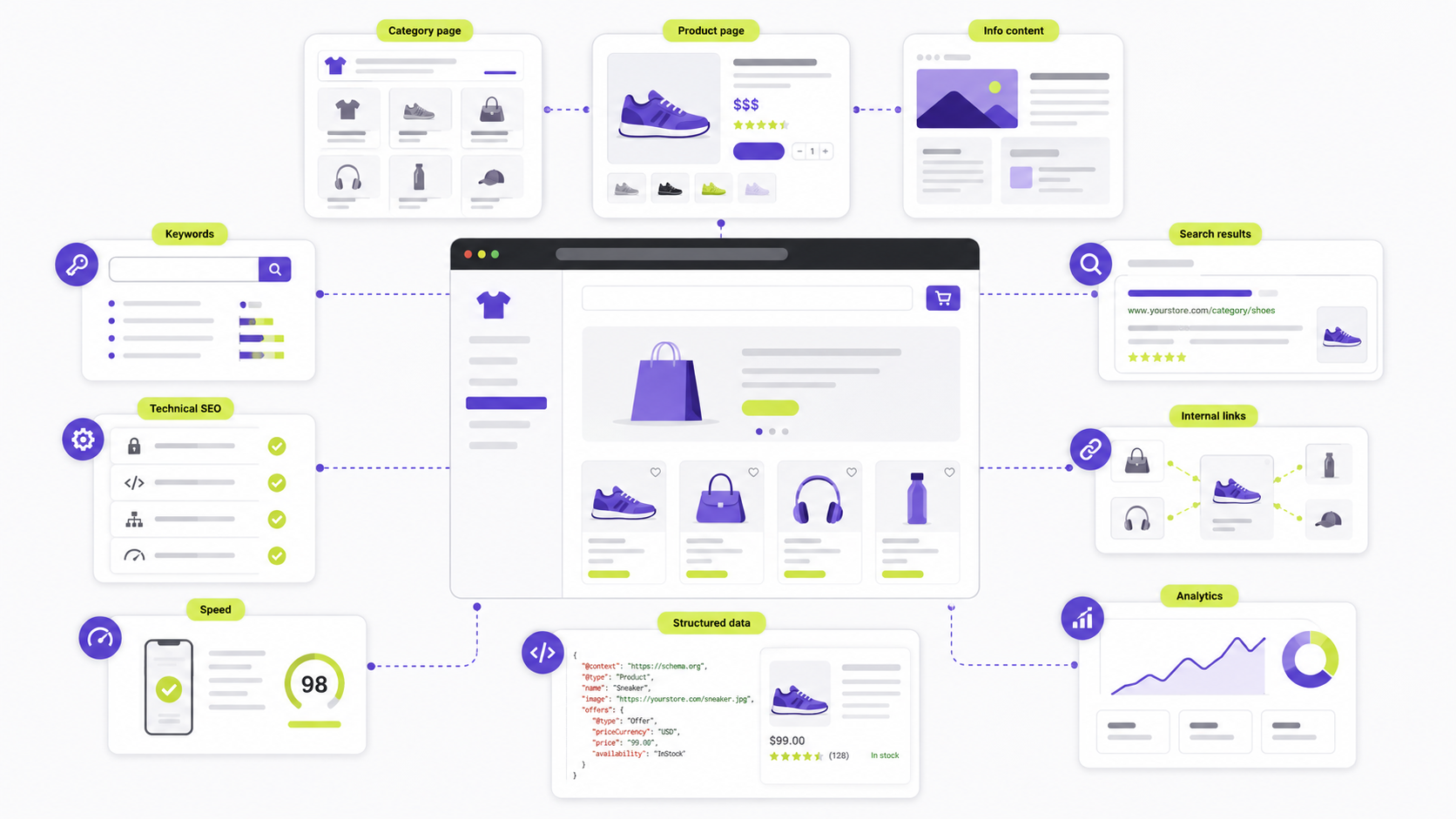
A strong e-commerce SEO strategy makes it easier for search engines to understand and index a store while creating a faster, clearer, and more convenient shopping experience for customers.
Is Your Online Store Built for Growth?
Improve performance and conversions.
How Is E-commerce SEO Different from Traditional SEO?
Traditional SEO and e-commerce SEO use many of the same methods, but their goals, target pages, and optimization challenges differ.
Area | Traditional SEO | E-commerce SEO |
|---|---|---|
Primary goal | Generate traffic, leads, or brand awareness | Increase product visibility and online sales |
Main pages | Blog posts, service pages, and landing pages | Product, category, and filter pages |
Search intent | Often informational or service-oriented | Mostly commercial and transactional |
Main challenges | Content competition and authority building | Duplicate content, large catalogs, filters, and dynamic URLs |
Key optimization areas | Content, keywords, backlinks, and local SEO | Product data, category structure, internal linking, structured data, and technical SEO |
Success metrics | Traffic, leads, and engagement | Organic revenue, transactions, and product conversions |
Because online stores may contain thousands of products and dynamically generated pages, e-commerce SEO requires a strong focus on site architecture, crawlability, indexing, and conversion-oriented search intent.
How E-commerce SEO Helps Online Stores Grow
E-commerce SEO helps online stores attract shoppers who are already searching for relevant products. Better visibility at different stages of the buying journey supports both traffic growth and sales.
Brings More Qualified Traffic
SEO helps product and category pages appear for relevant search queries. This attracts visitors with clear interest in the products a store offers.
Increases Product Visibility
Optimized pages make it easier for search engines to understand a store’s catalog and display its products for commercial and transactional searches.
Reduces Dependence on Paid Advertising
Unlike paid campaigns, organic pages can continue generating traffic without a cost for every click. Over time, this can create a more sustainable acquisition channel.
Improves the Shopping Experience
Many SEO improvements also benefit customers. Faster loading times, clear navigation, useful content, and a logical site structure make products easier to find and compare.
Supports Long-Term Revenue Growth
Higher visibility, qualified traffic, and a better user experience can lead to more conversions. While SEO usually takes time to deliver results, its impact can continue to grow as optimized pages gain stronger rankings and authority.
E-commerce SEO in Action: The Titan Rig Case
Technical performance and SEO improvements can directly affect how customers discover and use an online store. Transform Agency helped Titan Rig address several issues that were limiting its performance:
- optimized the website code and improved loading speed;
- strengthened the site structure and technical SEO setup;
- improved metadata, the XML sitemap, and robots.txt;
- helped key pages meet Core Web Vitals requirements;
- reduced loading times from more than 20 seconds to as little as 1.5 seconds on some pages.
As a result, the website became 6.5 times faster on average, while conversions and overall sales increased by 30% within the first three months. Read the full Titan Rig website optimization case study to see how these improvements supported measurable business growth.
Key Components of E-commerce SEO
E-commerce SEO is not a single activity. It combines several areas that work together to improve search visibility, attract relevant traffic, and support conversions.
Component | What It Covers | Why It Matters |
|---|---|---|
Keyword strategy | Product, category, commercial, and informational search terms | Connects store pages with the queries potential customers use |
Store structure | Categories, subcategories, navigation, URLs, and internal links | Helps users and search engines find important pages |
Page optimization | Titles, headings, descriptions, images, metadata, and product content | Makes each page more relevant to its target search intent |
Technical SEO | Crawling, indexing, page speed, mobile usability, canonical tags, sitemaps, and structured data | Prevents technical issues from limiting visibility |
Content strategy | Buying guides, comparisons, FAQs, and educational articles | Reaches customers before they are ready to purchase |
Authority building | Backlinks, brand mentions, reviews, and external references | Strengthens trust and competitiveness in search results |
These components should not be treated separately. For example, keyword research determines which pages a store needs, site architecture organizes those pages, on-page SEO improves their relevance, and technical SEO ensures they can be crawled and indexed. Content and authority building then expand the store’s reach and help it compete for more valuable search queries.
How to Build an E-commerce SEO Strategy
An effective e-commerce SEO strategy connects customer search behavior with the store’s structure, content, and technical performance. Follow these steps to improve visibility and turn organic traffic into sales.
1. Audit the Store’s Current SEO Performance
Review organic traffic, rankings, indexed pages, conversions, and revenue to understand the store’s current performance. Identify technical problems such as broken links, duplicate pages, missing metadata, indexing errors, and slow loading times, then prioritize issues that affect the largest or most valuable sections of the catalog.
2. Research Keywords and Search Intent
Find the terms customers use when researching, comparing, and buying products. Match broad commercial queries with category pages, specific product searches with product pages, and informational questions with guides or articles. Focus not only on search volume but also on how likely each query is to lead to a purchase.
3. Create a Clear Store Structure
Organize products into logical categories and subcategories that reflect how customers browse and search. Important pages should be easy to reach through navigation, breadcrumbs, and internal links, while each primary keyword should have one clearly defined target page.
4. Optimize Category and Product Pages
Category pages should target broader commercial searches through relevant titles, headings, descriptions, URLs, and internal links. Product pages should provide unique descriptions, specifications, images, availability details, reviews, and answers to common questions that help both search engines and shoppers understand the offer.
5. Strengthen Technical SEO
Make sure search engines can crawl and index the correct pages without wasting resources on unnecessary URL variations. Review canonical tags, redirects, XML sitemaps, robots directives, filters, pagination, mobile usability, page speed, and Core Web Vitals.
The platform itself also affects how much control you have over performance, URLs, structured data, and indexation. Compare the best e-commerce platforms for SEO to choose the right foundation for your optimization strategy.
6. Create Content for the Buying Journey
Publish buying guides, comparisons, FAQs, and how-to articles that answer questions customers ask before making a purchase. Each piece of content should target a specific search intent and guide readers toward relevant product or category pages.
7. Measure and Refine the Strategy
Track rankings, clicks, indexed pages, conversions, organic revenue, and the performance of individual landing pages. Use these insights to update declining content, resolve new technical issues, and focus resources on the pages and keywords with the strongest business potential.
The right tools can simplify keyword research, technical audits, competitor analysis, and performance tracking. Explore our guide to thebest e-commerce SEO tools to find the right solutions.
Common E-commerce SEO Mistakes to Avoid
Even a well-planned SEO strategy can underperform if common technical and content issues are left unresolved.
Mistake | Why It Hurts SEO | How to Fix It |
|---|---|---|
Using duplicate product descriptions | Makes pages less distinctive and may reduce their ability to rank | Create unique descriptions for priority products and categories |
Ignoring category pages | Misses valuable commercial search queries | Optimize category content, headings, metadata, and internal links |
Allowing filters to create unlimited URLs | Wastes crawl resources and creates duplicate pages | Control indexation with canonical tags, robots directives, and URL rules |
Removing out-of-stock products immediately | Can lose rankings, links, and returning visitors | Keep temporary out-of-stock pages live or redirect discontinued products appropriately |
Focusing only on traffic | May increase visits without improving revenue | Track conversions, organic revenue, and landing-page performance |
Neglecting mobile performance | Creates a poor experience for mobile shoppers | Improve loading speed, usability, and Core Web Vitals across devices |
Regular checks help identify these issues before they affect large parts of the catalog. A professional SEO audit can uncover technical problems, content gaps, and optimization opportunities that may be limiting your store’s organic growth.
If you plan to bring in external expertise, learn how to choose an e-commerce SEO agency before you compare providers or sign a contract.
How Long Does E-commerce SEO Take to Show Results?
E-commerce SEO rarely produces immediate results. The timeline depends on the store’s technical condition, authority, competition, catalog size, and the amount of work required.
Typical progress may look like this:
- First few weeks: improved crawling, indexing, page speed, and visibility for already established pages.
- 1–3 months: early ranking improvements, more impressions, and growth for less competitive keywords.
- 3–6 months: stronger visibility for product and category pages, increased organic traffic, and initial revenue growth.
- 6+ months: more stable rankings, broader keyword coverage, and a stronger contribution to long-term sales.
These timeframes are approximate rather than guaranteed. Consistent content updates, technical improvements, internal linking, and performance monitoring are essential for achieving sustainable growth.
How to Measure E-commerce SEO Success
SEO performance should be evaluated through both search visibility and business results. Rankings and traffic show whether a store is becoming easier to find, while conversions and revenue reveal whether that visibility contributes to growth.
Metric | What It Measures | Why It Matters |
|---|---|---|
Organic traffic | The number of visitors arriving from unpaid search results | Shows whether SEO is attracting more potential customers to the store |
Search impressions | How often store pages appear in search results | Helps measure visibility even before users begin clicking more frequently |
Keyword rankings | Positions for important product, category, and informational queries | Indicates which pages and search terms are gaining or losing visibility |
Organic click-through rate | The percentage of impressions that result in clicks | Shows how effectively page titles and descriptions attract searchers |
Organic conversions | Purchases and other valuable actions completed by organic visitors | Reveals whether search traffic reaches users with meaningful buying intent |
Organic revenue | Revenue generated directly or indirectly by organic search | Connects SEO performance with the store’s commercial results |
Conversion rate | The percentage of organic visitors who complete a purchase or another goal | Helps determine whether landing pages attract relevant users and support purchasing decisions |
Landing-page performance | Traffic, engagement, conversions, and revenue generated by individual pages | Identifies the product, category, and content pages that deliver the most value |
Indexed pages | The number of important pages included in the search index | Helps detect indexing problems, duplicate pages, and gaps in catalog visibility |
Backlinks and referring domains | External websites linking to the store | Indicates whether the store is building authority and trust in its market |
These metrics should be assessed together and compared over time. For example, growing traffic may have limited value if conversions remain unchanged, while a smaller increase in highly relevant product searches can generate a stronger revenue impact.
Is E-commerce SEO Worth the Investment?
E-commerce SEO requires time, expertise, and continuous improvement, but it can become one of the most sustainable customer acquisition channels for an online store. Unlike paid advertising, optimized pages can continue attracting visitors without requiring payment for every click.
Its value is especially strong for stores with:
- products that customers actively search for online;
- large catalogs with many category and product opportunities;
- high advertising costs or strong reliance on paid traffic;
- plans for long-term growth rather than short-term campaigns;
- enough resources to maintain technical quality and update content.
SEO is unlikely to replace every other marketing channel, but it can reduce dependence on advertising, strengthen brand visibility, and attract customers throughout the buying journey. Its real value should be measured through qualified traffic, conversions, revenue, and the long-term cost of customer acquisition.
Turn Search Visibility into Sustainable Growth
E-commerce SEO helps online stores connect with customers throughout the buying journey, from early product research to the final purchase. A clear strategy that combines relevant content, strong technical performance, and continuous optimization can turn organic search into a reliable source of qualified traffic and revenue.
Ready to turn organic search into a stronger source of traffic and revenue? Transform Agency can help you identify growth opportunities, resolve technical issues, and build a sustainable SEO strategy for your online store.
FAQ
What should an e-commerce SEO strategy include?
An e-commerce SEO strategy should include keyword research, site architecture, category and product page optimization, technical SEO, internal linking, content creation, authority building, and performance tracking. These elements should work together to improve visibility, attract relevant shoppers, and support conversions.
What is e-commerce on-page SEO?
E-commerce on-page SEO is the process of optimizing individual product, category, and content pages for search engines and users. It covers titles, headings, descriptions, URLs, images, internal links, metadata, structured data, and page content that matches the intended search query.
What are the best e-commerce SEO tips for beginners?
Beginners should start by researching how customers search for their products, improving the store’s category structure, and optimizing the most valuable product and category pages. It is also important to fix indexing issues, write unique content, improve mobile performance, and track organic traffic, conversions, and revenue.
How is SEO for e-commerce websites different from regular SEO?
E-commerce SEO focuses more heavily on commercial and transactional searches, large product catalogs, category pages, filters, product variations, and duplicate URLs. It also connects optimization more directly with product visibility, conversions, and online revenue.
Does your online store need a seasonal SEO strategy?
A seasonal SEO strategy can be valuable if demand changes around holidays, sales periods, events, or specific times of year. Stores should prepare relevant landing pages and content in advance, optimize them for seasonal queries, and keep useful pages live for future campaigns instead of recreating them each year.

Katherine specializes in enhancing e-commerce performance through strategic optimization and digital marketing. Combining 5+ years of experience in marketing with strong programming expertise, she helps online businesses improve their visibility, strengthen their online presence, and achieve better results.

Expert in creating engaging written content. Skilled at analyzing audience behaviors and refining strategies to align business goals with customer interests. Proven ability to craft content that connects deeply with audiences. Passionate about staying current with trends to boost engagement.