0%
The top three Google results receive 68.7% of all clicks, so SEO can become a major growth channel for an online store. However, e-commerce SEO demands expertise in technical optimization, site structure, content, and conversion strategy.
The wrong agency can waste your budget, reduce search visibility, and attract traffic that does not convert. This guide provides a practical checklist, key questions, and common red flags to help you choose the right e-commerce SEO partner.
What Does an E-commerce SEO Agency Do?
An e-commerce SEO agency helps online stores gain more visibility in search results and turn organic traffic into revenue. Understanding how e-commerce SEO works can help you assess whether an agency covers all important areas.
Unlike a general SEO provider, it works with large product catalogs, category pages, filters, duplicate content, crawl budget, and seasonal demand.
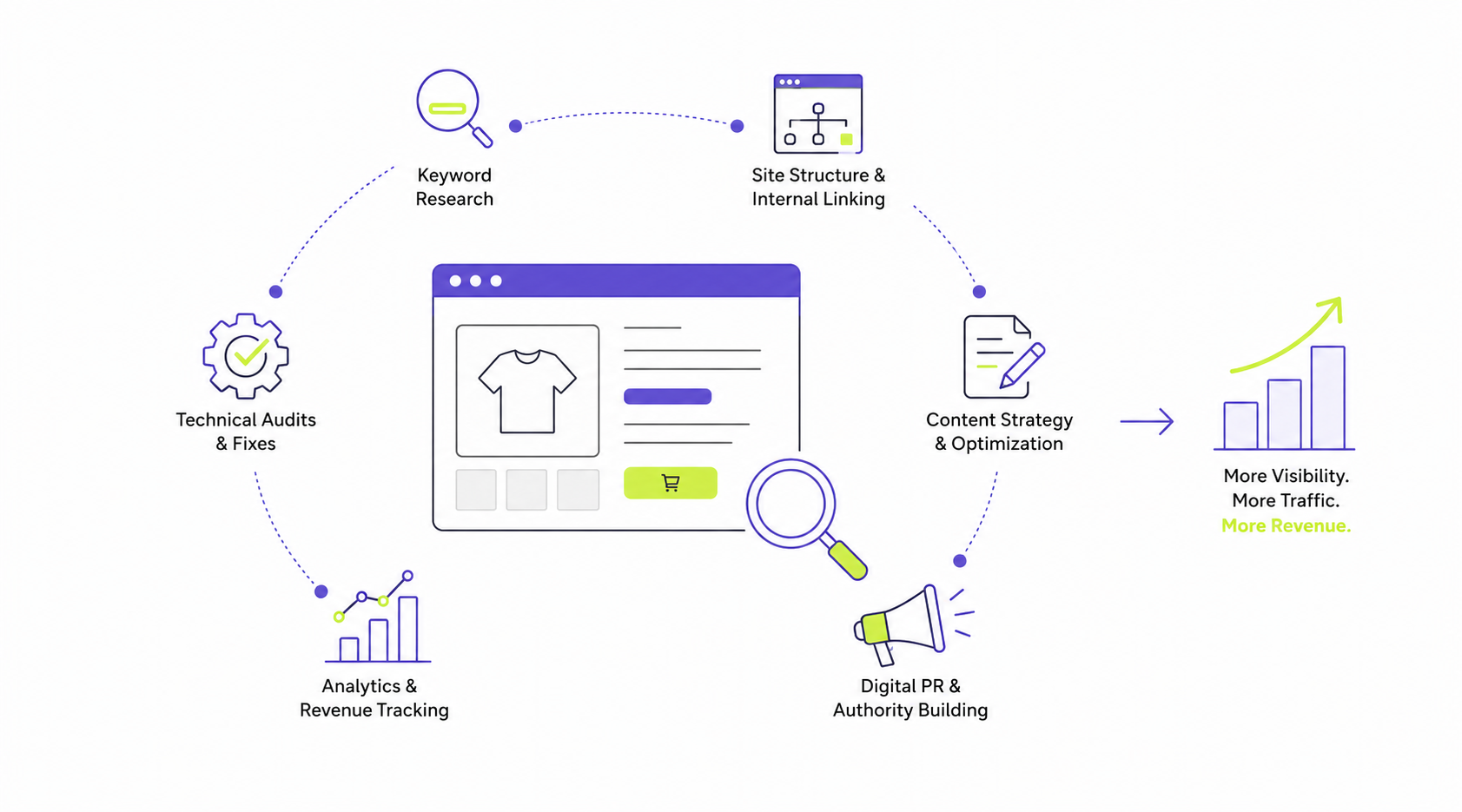
A reliable agency should cover:
- Technical audits and fixes
- Keyword research for product, category, and blog pages
- Site structure and internal links
- Content strategy and optimization
- Digital PR and authority growth
- Analytics, revenue attribution, and clear reports
Its goal should go beyond higher positions and more traffic. The agency should connect SEO results to sales, conversions, customer acquisition costs, and long-term growth.
Why E-commerce Requires a Specialized SEO Agency
E-commerce websites present challenges that standard business sites rarely face. A store may contain thousands of product, category, filter, and variant pages, so one technical error can affect a large part of the website.
A specialized e-commerce SEO agency understands how to address:
- Complex site architecture: Categories, subcategories, filters, and product variants require a clear structure for users and search engines.
- Duplicate and low-value pages: Filters, sorting options, and URL parameters can create thousands of similar pages and waste crawl resources.
- Frequent catalog changes: New products, unavailable items, price updates, and seasonal collections require a consistent SEO approach.
- Commercial search intent: Product and category pages must attract users who are ready to compare options or make a purchase.
- Platform-specific limits: Magento, Shopify, WooCommerce, and other platforms have distinct URL structures, templates, and technical requirements.
- Revenue-focused priorities: The agency must connect SEO decisions to conversions, transactions, and organic revenue, not traffic alone.
This expertise helps an online store avoid large-scale technical issues, improve the visibility of high-value pages, and turn organic search into a reliable sales channel.
Ready to Grow Through Search?
Improve your visibility, attract high-intent traffic, and turn organic search into revenue.
How to Choose an E-commerce SEO Agency: 10-Point Checklist
The right agency should understand both search engines and the commercial needs of an online store. Use the following checklist to compare providers, verify their expertise, and determine whether their approach can support measurable business growth.
1. Define Your SEO Goals
Set clear goals before you contact an agency. This will help you assess whether its proposed strategy matches your priorities.
Your goals may include:
- More organic revenue
- Higher visibility for product and category pages
- Less dependence on paid advertising
- Expansion into new markets
- Recovery after a traffic decline
- SEO support during a redesign or platform migration
Avoid broad goals such as “get more traffic.” A strong agency should connect each objective to measurable outcomes, such as transactions, qualified leads, conversion rates, or revenue.
2. Check Its E-commerce Experience
General SEO experience does not always translate into e-commerce expertise. Ask whether the agency has worked with stores that have a similar catalog size, target market, sales cycle, or business model.
Relevant experience helps an agency understand common issues such as duplicate product pages, seasonal collections, inventory changes, filters, and large-scale content updates. It should also know how to prioritize pages with the highest commercial value.
3. Confirm Platform Expertise
Magento, Shopify, WooCommerce, BigCommerce, and other platforms have different technical structures and limits. A comparison of the best e-commerce platforms for SEO can help you understand which platform-specific skills an agency should have. An agency that knows your platform can identify risks faster and recommend changes that your team can implement.
Ask for examples of work with your platform and clarify which technical tasks the agency handled. Basic familiarity is not enough for stores with custom themes, extensions, integrations, or complex catalogs.
4. Review Its Technical SEO Skills
Technical SEO provides the foundation for all other work. Even strong content may fail to rank when search engines cannot crawl, understand, or index the right pages.
The agency should know how to assess:
- Site architecture
- Crawlability and indexation
- Canonical tags
- Faceted navigation
- XML sitemaps
- Structured data
- Core Web Vitals
- Redirects and broken links
- JavaScript content
- Mobile usability
Ask what its technical audit includes, how it sets priorities, and who will implement the fixes. A long issue list has little value without clear recommendations and an action plan.
5. Assess Its Product and Category Page Strategy
Product and category pages often attract visitors with the strongest purchase intent. The agency should have a clear plan for these pages rather than focus most of its effort on blog content.
Ask how it selects priority pages, maps keywords, improves page copy, strengthens internal links, and prevents competition between similar URLs. It should also account for product variants, unavailable items, seasonal pages, and categories with limited content.
6. Examine Its Content Strategy
A reliable content strategy should support the customer journey and commercial pages. Blog traffic alone does not guarantee sales.
The agency should explain how it:
- Identifies customer questions and search intent
- Selects topics with business value
- Links informational content to relevant products and categories
- Updates content that has lost visibility
- Prevents keyword overlap between pages
- Measures content performance beyond page views
Look for a clear connection between content, search demand, and revenue opportunities.
7. Ask About Link Building and Digital PR
Quality backlinks can strengthen authority, but poor methods may create long-term risks. Ask how the agency selects websites, evaluates link quality, and reports acquired placements.
Avoid agencies that hide their sources or promise a fixed number of links without context. A trustworthy provider should explain its methods and focus on relevance, editorial value, and domain quality rather than volume alone.
8. Review Relevant Case Studies
Case studies should show more than impressive percentages. Look for projects with a similar platform, market, catalog structure, or SEO challenge.
A useful case study should include:
- The client’s initial problem
- The project goals
- The actions the agency took
- The time required
- The effect on traffic, conversions, and revenue
Ask how the agency separated SEO impact from seasonality, promotions, paid campaigns, and other factors. This will show how carefully it evaluates results.
9. Check Its Reports and KPIs
SEO reports should show how organic search affects business results, not just positions and traffic. Before you choose an agency, ask which metrics it includes, how often it provides reports, and how the team explains performance changes.
KPI | What It Shows | Why It Matters |
|---|---|---|
Organic revenue | Revenue from organic search | Connects SEO work directly to sales |
Transactions or leads | Conversions from organic visitors | Shows whether traffic has commercial value |
Conversion rate | The share of visitors who convert | Helps assess traffic quality and page performance |
Non-brand traffic | Visits from searches without the company name | Shows whether SEO reaches new customers |
Category and product visibility | Search performance of commercial pages | Reflects visibility for high-intent queries |
Technical SEO health | Indexation, crawl, speed, and error status | Shows whether technical issues limit growth |
The agency should also explain what caused each major increase or decline and what actions it plans next. Reports that contain only rankings, impressions, or total traffic may hide weak commercial results.
10. Evaluate Communication and Implementation Support
SEO often requires cooperation between marketers, developers, content teams, and business stakeholders. Clear communication can determine whether recommendations become real improvements.
Before you sign a contract, clarify:
- Who will manage the account
- Which specialists will work on the project
- How often meetings will take place
- How quickly the team will respond
- Who will implement technical changes
- How the agency will prioritize tasks
- What support it will provide to your developers
The agency should explain its process clearly and set realistic expectations. Vague answers at the proposal stage may signal poor communication after the project starts.
A strong e-commerce SEO agency will meet most or all of these criteria. It will combine platform knowledge, technical expertise, commercial awareness, transparent reports, and a strategy that links search visibility to business results.
How to Compare Agency Proposals
SEO proposals can look similar at first, but the scope, team, and level of support may differ significantly. Compare each offer by value and relevance, not price alone. If you have not created a shortlist yet, compare leading e-commerce SEO agencies before you rate their proposals against the criteria below.
Rate every agency from 1 to 5 across the following areas:
Evaluation Area | What to Compare |
|---|---|
E-commerce expertise | Experience with your platform, market, and catalog size |
Proposed strategy | Clear priorities based on your store and business goals |
Scope of work | Defined tasks for technical SEO, content, links, and analytics |
Technical support | Responsibility for fixes and cooperation with developers |
Project team | Named specialists, roles, and level of involvement |
KPIs | Focus on revenue, conversions, and commercial page visibility |
Reporting | Frequency, insights, completed work, and next steps |
Pricing | Included services, additional fees, and payment terms |
Timeline | Realistic milestones without guaranteed rankings |
Contract terms | Notice period, asset ownership, access, and handover |
A low-cost proposal may exclude content, development, or link acquisition, while a higher fee may include a broader team and direct implementation support. Choose the agency that offers the clearest scope, the most relevant expertise, and the strongest connection between SEO work and business results.
E-commerce SEO Agency Red Flags
A polished proposal does not always indicate strong expertise. Watch for the following warning signs before you choose an agency.
Guaranteed Rankings
No agency can guarantee a specific Google position or promise results by an exact date. SEO outcomes depend on competition, website condition, algorithm changes, and implementation speed.
A Generic SEO Strategy
The proposed plan should reflect your platform, catalog, market, and business goals. A standard package for every client may fail to address the specific needs of your store.
No Relevant E-commerce Case Studies
General SEO results do not prove experience with product catalogs, filters, variants, seasonal pages, or inventory changes. Ask for examples from comparable e-commerce projects.
Traffic as the Main Success Metric
More organic visits do not always lead to more sales. The agency should also track transactions, conversion rates, commercial page visibility, and organic revenue.
Vague Deliverables
Terms such as “ongoing optimization” or “monthly SEO support” provide little clarity. The proposal should define tasks, priorities, expected outputs, and responsibilities.
Hidden Link-Building Methods
The agency should explain how it obtains links and evaluates their relevance and quality. A lack of transparency may indicate risky or low-value tactics.
Poor Communication
Slow replies, unclear roles, and evasive answers before the contract may continue after the project starts. A reliable agency should define contacts, reporting schedules, and response expectations.
Unclear Ownership and Exit Terms
Your company should retain access to analytics accounts, reports, content, data, and other project assets. The contract should also explain cancellation terms and the handover process.
Choose an Agency That Supports Revenue Growth
The right e-commerce SEO agency should offer more than rankings and traffic. It should understand your platform, catalog, customers, and commercial goals, then turn that knowledge into a clear and measurable strategy.
Use this checklist, key questions, and red flags to compare providers with confidence. For an e-commerce SEO strategy focused on qualified traffic, conversions, and revenue, bring your goals to Transform Agency. Our team will identify high-impact opportunities and build a practical roadmap for sustainable organic growth.
FAQ
What services should an e-commerce SEO agency provide?
An e-commerce SEO agency should cover technical audits, keyword research, product and category page optimization, site architecture, content, internal links, authority growth, and performance reports. It should connect its work to conversions and organic revenue rather than focus on rankings alone.
What should I ask an SEO agency before hiring?
Ask about its experience with similar stores, platform expertise, initial priorities, technical audit, link-building methods, project team, implementation support, and KPIs. You should also clarify the scope, additional costs, contract terms, and ownership of content and accounts.
How much do e-commerce SEO services cost?
The cost depends on the store’s size, platform, competition, target markets, and scope of work. Compare what each fee includes, such as technical support, content, digital PR, and implementation, rather than choose an agency by price alone.
How long does it take to see results from e-commerce SEO?
Many stores begin to see measurable progress within three to six months, but competitive or technically complex websites may need longer. The timeline also depends on the site’s condition, implementation speed, available resources, and market competition.

Expert in creating engaging written content. Skilled at analyzing audience behaviors and refining strategies to align business goals with customer interests. Proven ability to craft content that connects deeply with audiences. Passionate about staying current with trends to boost engagement.
Expert in creating engaging written content. Skilled at analyzing audience behaviors and refining strategies to align business goals with customer interests. Proven ability to craft content that connects deeply with audiences. Passionate about staying current with trends to boost engagement.